

Honestly, before yesterday, I had never considered that yoga instructors might use LLMs like ChatGPT to help design their class sequences. I was attending a lecture on AI and creativity when it suddenly occurred to me that AI could be used for sequencing yoga sessions. A quick Google search confirmed that, as usual, I’m quite behind the times. People are already incorporating AI into their class planning.
My first thought? Why did I never think of that? I can sit for hours on my mat with my notebook, trying out different transitions and jotting them down as quickly as I can before I forget. As a result, I have notebooks full of tried-and-tested sequences to teach to my students.
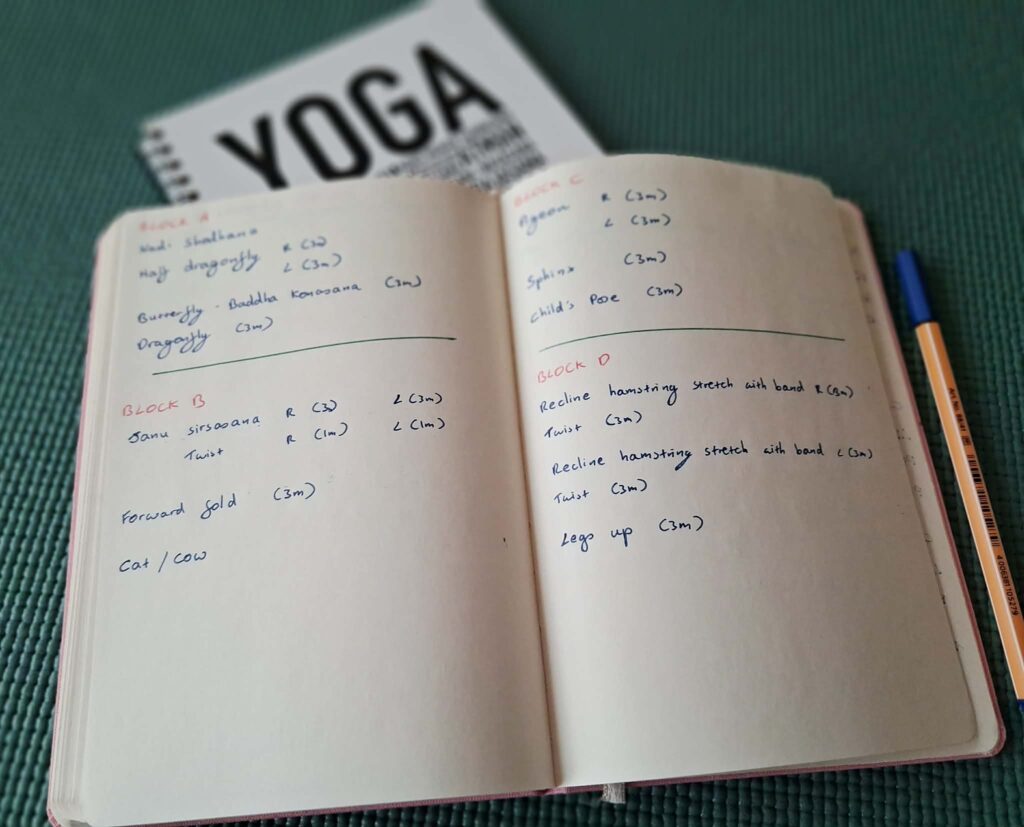
It takes time to plan a class. Sometimes a lot of time, depending on what I’m hoping to teach the students on any particular day. Of course, I have all my notes with suggestions from various trainings I’ve been on. There’s also an endless amount of inspiration to be found online or in books, not to mention some of the wonderfully creative sequences I’ve learned from other teachers I’ve practiced with.
But wouldn’t it be so much quicker to type a prompt into ChatGPT and let it do all the hard work with much less effort from me?
Like I said, that was my first thought, and yet I still haven’t typed any prompts into the input box. Instead, earlier today, while I was outside preparing the garden for the sowing season, I found myself planning tomorrow’s yin class in my head. Once I’ve finished writing this post, I’ll jot my ideas down in a notebook, all set for the session.
So why not use ChatGPT instead?
I certainly wouldn’t chastise anyone for using it, especially for inspiration. In the workshop part of yesterday’s lecture, we used ChatGPT to plan a drama lesson, and I have to admit that the results were pretty good. The lesson was well structured, with clear aims and goals. It would make a great starting point for a lesson plan, tweaking it here and there to suit specific students. The point is, however, that it still needs a human’s insight for the lesson to work in practice. ChatGPT doesn’t know your students. It’s not there with you in the class, ready to adapt poses on the spot when you see someone struggling, or quickly change or eliminate a sequence when you realise that you planned a class for a mixed-age group and everyone who turned up happens to be 70+.
The human element of yoga is essential. I believe that, as a teacher, you need to have experienced the flows and transitions yourself in order to teach them well so you can modify them, explain them clearly, and provide assists where necessary. Simply allowing an LLM to write a sequence and saying “done” isn’t going to make that possible.
Also, the process of creating is something we need to allow to take time. When we type a prompt into ChatGPT, we get an instant reply. But part of the joy (and frustration) of the creative process is letting ideas slowly take shape while doing the dishes, taking a shower, or going for a walk. Or, as was the case for me today, working in the garden.
We live in such a fast-paced society, and yoga gives us the opportunity to slow down, take a breath, and be present. Shouldn’t the same also be true when preparing for a class? That being said, most yoga teachers have other jobs and are trying to squeeze class preparation into the spaces in between coming home from work, making dinner, putting the kids to bed, and doing everything else that fills a normal day. So can you really blame anyone for looking for ways to make life a little easier?
For now, though, while I still have the inspiration, the time, and the energy, I’ll continue to roll out my mat, put on some relaxing music, and write down my ideas in my notebooks. My hope is to share some of those sequences here on this site, and maybe provide a bit of inspiration for anyone who, like me, is still a little sceptical about using LLMs to plan their classes.

P.S. I haven’t mentioned the environmental impact of AI, which is also something to consider. I’m far from an expert in that area, but you can read about some of the issues on MIT‘s website.
Also, here’s a link to an older, but still interesting video from YogaRenew, about a yoga teacher’s experience of using ChatGPT to write a vinyasa sequence: Can ChatGPT Write a Vinyasa Sequence?