
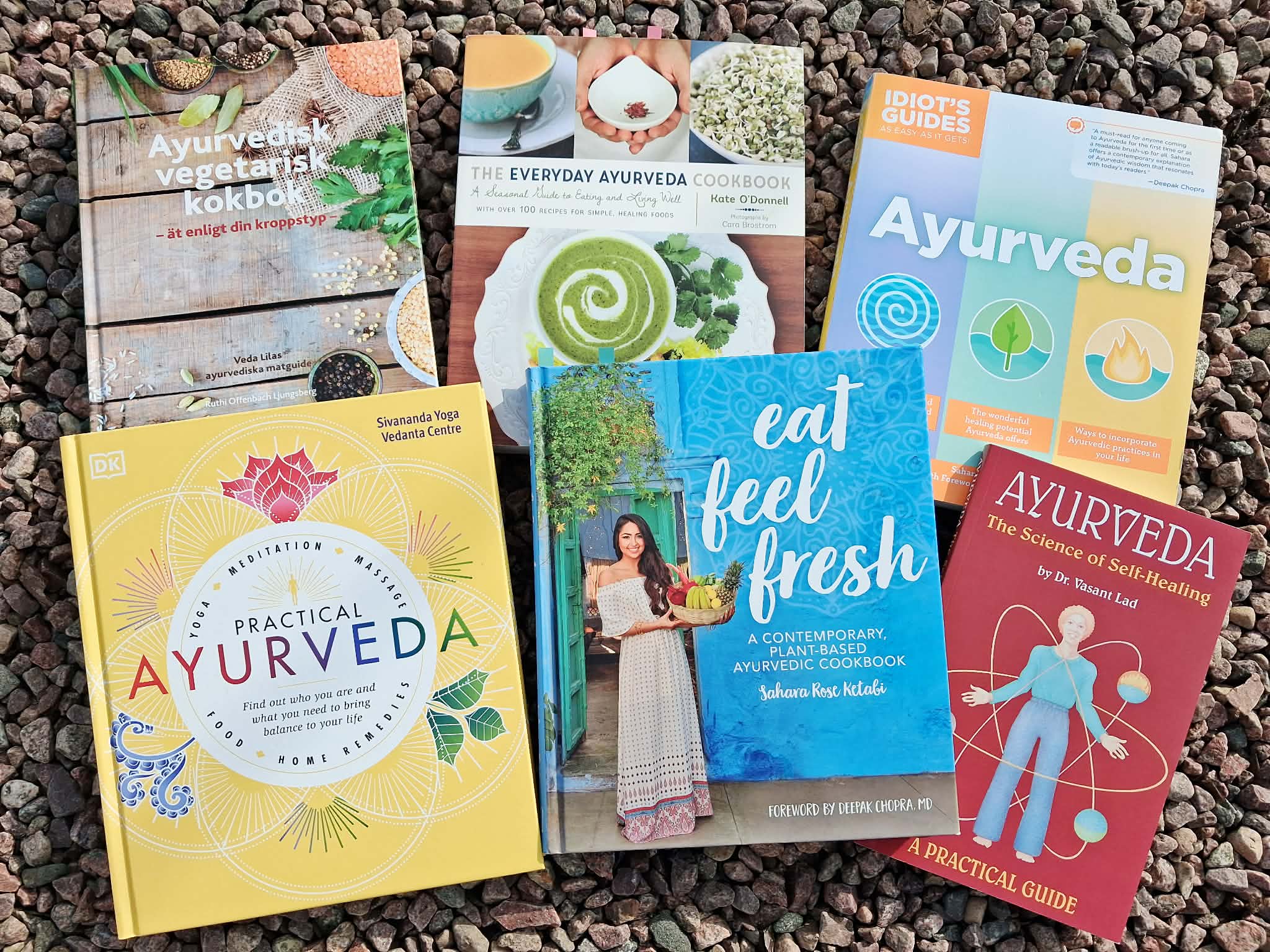
Add the spring weather to the fact that I’m currently furthering my studies in Ayurvedic nutrition and I find myself gathering together all my Ayurveda books for renewed inspiration. One of them still smells of incense from the lovely shop in Malmö where I bought it: Sök och Finn. Definitely worth a visit if you’re ever in the area.

There are many books on Ayurveda, but here are some of the ones I’ve collected over the years and use for both reference and recipes.
The Everyday Ayurveda Cookbook, Kate O’Donnell
I’ve lost count of how many times someone has recommended this book to me. The first was a yoga teacher whose classes I attended in Sweden. She also ran a café and loved incorporating Ayurvedic principles into the food she served.
As the title suggests, this is a cookbook, organised by season. It includes shopping lists, lifestyle guidelines, and a wide variety of recipes covering breakfast, lunch, dinner, desserts, and drinks. The recipes are easy to follow and most of the ingredients can be found in a regular grocery store.
I really love the beautiful photographs. It’s helpful to see what the final dish is supposed to look like, even if my own cooking rarely looks quite so appealing. Still, as long as it tastes good (which these recipes certainly do), that’s what really matters.
Eat Feel Fresh. A Contemporary Plan-Based Ayurvedic Cookbook, Sahara Rose Ketali
This book is like a rainbow, it’s so full of colour.
After a foreword by Deepak Chopra, the book opens with the author sharing her own journey with Ayurveda. This is followed by a brief overview of Ayurvedic principles and the doshas, along with quizzes to help you discover your own doshic constitution.
There are suggested meal plans, shopping lists, and recipes designed to suit each dosha. The book also includes suggestions for adapting recipes depending on whether your constitution is more kapha, pitta, or vata.
The pictures are stunning and the recipes mouthwatering, although some of the ingredient lists are rather long. Still, simply opening the book sparks excitement at the thought of preparing vibrant, healthy meals.
Practical Ayurveda, Sivananda Yoga Vedanta Centre
I do wish there were more photographs in this book. There are a few, but not nearly as many as in my other recipe books. That said, this is less of a cookbook and more a book about yoga and Ayurveda, which makes sense considering the book’s origins.
There is a lot of information contained within, organised under the following headings:
- You and Your Body
- The Ayurvedic Lifestyle
- Maintaining Good Health
- Food, Diet, and Recipes
- Yoga: Asanas, Pranayama, and Relaxation
- Positive Thinking and Meditation
- Seeing an Ayurvedic Practitioner
- Home Remedies for COmmon Ailments
There are also plenty of illustrations and helpful subheadings, which make the book easy to navigate.
One thing I particularly like is the section on remedies for common ailments, which can be used alongside professional treatment where appropriate. I also like the way the book highlights the connection between yoga and Ayurveda, often referred to as yoga’s “sister science.”
Finally, there’s an introduction to what it’s like to visit an Ayurvedic practitioner, which can feel like a daunting and unfamiliar experience if you have no idea what to expect.
Overall, there’s a lot of interesting information here for anyone curious about learning more about Ayurveda and how it connects with yoga.
Ayurveda. The Science of Self-Healing. A Practical Guide, Dr. Vasant Lad
This is without doubt the go-to book for learning about Ayurveda, and it was one of the texts recommended during my first yoga teacher training.
There’s a lot of information to take in, but it’s written in a very accessible way, making it suitable both for beginners and for anyone looking for a solid reference book to return to again and again.
Inside you’ll find background on the history and philosophy of Ayurveda and its relationship with yoga, along with detailed explanations of the doshas, disease, diagnosis, diet, lifestyle practices, and herbal medicines, including instructions for creating a “kitchen pharmacy.”
The only thing I find slightly lacking is a stronger emphasis on consulting a physician before using herbal remedies, as they may interact with certain medications. The book does mention consulting a doctor if symptoms persist, but in some cases it’s wise to seek medical advice beforehand.
That said, as with any book on health, it’s always important to apply your own judgement and common sense when trying out suggested remedies, especially in a world where new health information seems to appear constantly.
Overall, this is a book I’d highly recommend to anyone curious about or studying Ayurveda.
Idiot’s Guide: Ayurveda, Sahara Rose Ketabi
Another book by Sahara Rose Ketabi, but this time a simple, quick, and easy introduction to Ayurveda.
This guide isn’t filled with colourful photographs like Eat Feel Fresh, but what it lacks in visual appeal it more than makes up for in content.
It’s a great book for anyone new to Ayurveda. The structure is clear and it covers everything you need to begin incorporating Ayurvedic principles into everyday life.
Inside you’ll find dosha quizzes, food suggestions, recipes, and lifestyle practices, along with ideas for creating a morning routine and inspiration for Ayurvedic evening rituals.
There’s also a guide to Ayurvedic healing, home remedies, and even a section dedicated to women’s health.
As I said, if you’re completely new to Ayurveda, this is a great place to start.
Ayurvedisk vegetarisk kokbok – ät enligt din kroppstyp, Ruthi Offenback Ljungsberg
This is the book that still smells strongly of incense from the shop where I bought it.
It’s written in Swedish, but these days there are apps that can translate text just by pointing your phone camera at a page so technically anyone could use it, even if you don’t speak Swedish.
This is mainly an Ayurvedic cookbook, though it does include a short introduction to Ayurveda and the doshas, along with a checklist to help you identify your own constitution.
The rest of the book is organised by meal type: breakfast, lunch, dinner, desserts/snacks, and drinks.
Each recipe is accompanied by a photograph and a helpful key at the top indicating which dosha the meal is best suited for. This is a particularly useful feature when planning meals.
In general, the recipes require relatively few ingredients, and most can be found in an ordinary grocery store. Personally, I tend to avoid recipes with long ingredient lists, as they can quickly become complicated and expensive.
At the back of the book there’s a long food list explaining which foods are particularly suitable or unsuitable for each dosha. It’s a handy reference when you’re in a hurry. Even though Ayurveda encourages us to slow down, we all find ourselves rushing to plan our meals from time to time.
If you’re curious about Ayurveda, any one of these books could be a wonderful place to begin.